
A tree leaning towards your house is not automatically a hazard. What matters is whether the lean is old and stable or new and moving. Check the ground at the base, the trunk, and the canopy for signs that the roots have let go. If anything about it looks recent, get a professional risk assessment before storm season.
Why Do Trees Lean in the First Place?
Some trees lean because they grew that way, reaching around a roofline for light or standing on a slope. The tree built that shape and has held it since.
Others lean because something underground gave way: saturated soil after a long rain, roots cut during a driveway project, decay in the root collar. From the porch, the two look identical.
UF/IFAS notes that not all leaning trees are dangerous. One homeowner has watched a water oak lean over the garage for fifteen years. Another noticed Sunday that a pine looks wrong.
What’s the Difference Between an Old Lean and a New One?
Almost every decision about a leaning tree starts with how long it has been leaning.
A tree that has leaned for years has been reinforcing itself the whole time. UF/IFAS describes long-standing leans as showing an enlarged lower trunk, called compression wood, with branches sweeping back upward toward vertical.
A lean that formed quickly is the opposite. The same publication is direct: leans that developed rapidly, such as after a severe storm, indicate partial root failure and require immediate attention. Nothing has adapted. The roots stopped holding.
There is a real difference between a tree that fails with no warning and a tree that spent two years showing you it was failing. The second one is why we wrote this. Our post on how to tell when a tree needs to be removed covers general decline. This one stays on the lean.
What Should You Check on a Tree Leaning Towards Your House?
Do this in daylight a day or two after rain, when soft ground still shows movement.
- Soil on the high side of the lean. Cracked ground, a raised hump of turf, or soil pulling away from the base. That is the root plate lifting.
- The base of the trunk. Conks or mushrooms at the root collar, soft bark, or a trunk that enters the ground like a fence post.
- The trunk. Vertical seams, open cracks, cavities, old wounds on the stretched side.
- The canopy. Deadwood held in the crown, thin foliage next to the same species nearby, or most of the weight out over the lean.
- What sits underneath. A bedroom, a roof valley, where the cars park, the power drop.
- Whether it has moved. Photograph it from a fixed spot, then repeat after the next storm.
Anything on that list, and our tree removal crew should see it before the weather does.
When Does a Leaning Tree Become Urgent?
Four findings move a tree from watch it to handle it.
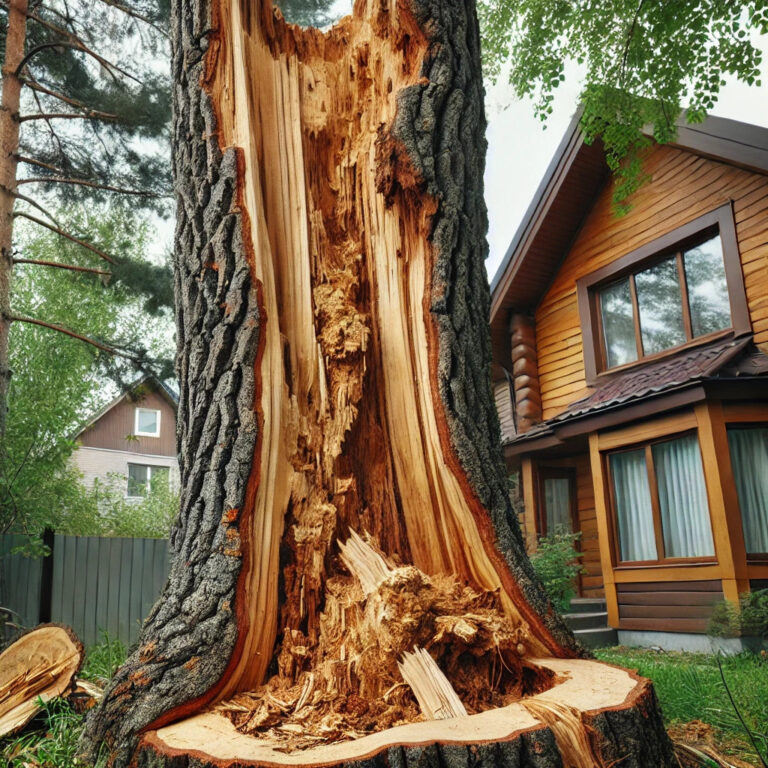
- A lifted root plate. UF/IFAS states that leaning trees with a lifted root plate should probably be removed, because the roots are already broken and the trunk’s structural support is gone.
- A lean that keeps increasing. Your photos are the evidence here.
- Fungal fruiting bodies at the base. Root collar decay eats the wood a leaning tree depends on.
- A dead tree that also leans. Dead tree removal near a structure goes to the top of our list.
Keep people and vehicles out from under a tree in that condition, and leave the cutting alone. Our safety page covers what we bring to a job like that: a Nifty64 bucket lift with a working height up to 70 feet, rigging ropes rated at 20,000 pounds, and a fully remote-controlled BIK TC-70 grapple saw truck that lifts from 70 feet of vertical reach. Limbs come down under control instead of dropping.
Where Does a Tree Risk Assessment Take Over?
Your walk-around answers one question: is there a reason to worry. A tree risk assessment answers the harder ones. How likely is failure, and what would it hit.
Brazzi Smith holds the ISA Tree Risk Assessment Qualification, known as TRAQ, a standardized process for assessing tree risk that requires retraining and retesting every seven years. He is also an ISA Certified Arborist, the broader credential. Two separate things, and he holds both.
He does the assessment himself, standing under the tree, not from a photo texted to an office. If the tree stays, you know what to watch and why. If it has to come down, you know what he saw. More on how Precision started is on our about page.

Does a Leaning Tree Always Have to Come Down?
No. Plenty of leaning trees around Live Oak and Lake City are sound and will stay that way. Three outcomes are realistic.
- Monitor it. A grown-in lean with sound roots and a healthy canopy gets documented and rechecked.
- Reduce the load. Tree pruning takes weight off the leaning side and the branch ends, shortening the lever arm working against the roots. See our trimming and pruning services.
- Remove it. When the structural roots are gone or the tree is dead, removal is the honest answer and we say so.
We would rather tell you a tree is fine and lose the job.
Frequently Asked Questions
What should I do if a tree is leaning towards my house?
Check the ground at the base for cracked or mounded soil, then the trunk and canopy, and photograph it from a fixed spot. If the lean is new, the soil has lifted, or the tree is dead, have an arborist assess it in person.
Should I be concerned about a leaning tree?
Concerned enough to look at it properly, yes. A lean the tree grew into over decades is often stable. One that appeared after a storm, or that has visibly increased, warrants a professional assessment.
How long can a tree lean before falling?
There is no reliable timeline, and anyone who gives you one is guessing. Some leaning trees stand for decades. Others fail in the first hard storm after their roots let go. Failure follows the roots, trunk, and soil, not the angle.
Is a dead leaning tree more urgent than a living one?
Yes. A dead tree has stopped producing the reinforcing wood that holds a lean together, and decay keeps working while it stands. Dead tree removal near a house is one job we tell homeowners not to put off.
Does homeowners insurance cover a leaning tree?
That depends on your policy, so read yours or call your agent rather than assume. Coverage often turns on whether the tree failed from a covered event or from a condition that was visible and left unaddressed.
What to Do Before Storm Season
Book the assessment ahead of the season, not during it. Once storms start, crews across North Florida are tied up on emergency work and a preventable removal becomes a scramble.
If a tree is leaning towards your house and you cannot tell whether it is a problem, call 386-688-5173 or request a consultation. Brazzi will walk the property with you. We cover a 50-mile radius from Live Oak, reaching Lake City, Madison, Perry, Branford, and north Gainesville. More answers are on our FAQ page.
